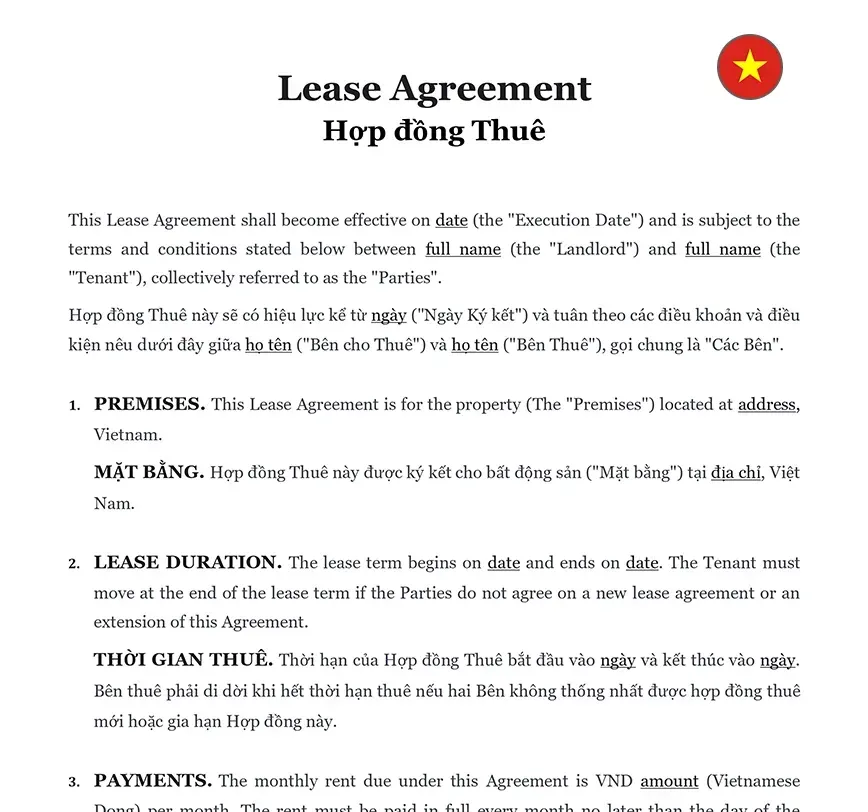
Short answer: Foreigners can legally rent an apartment in Vietnam with a written lease. Notarization is not required for a residential lease under the 2023 Housing Law. A good lease names both parties, describes the unit, and fixes the rent, deposit, term, notice period and who pays which bills. It should also say which language prevails, and that the landlord registers your temporary residence with the police.
Below is how leases actually work in Ho Chi Minh City in 2026, what the law says, and a clause-by-clause checklist to use before you sign.
This guide is general information, not legal advice. For a high-value or unusual lease, have a lawyer review it.
Is a lease with a foreigner legally valid in Vietnam?
Yes. Foreigners who are legally in Vietnam (on a visa, temporary residence card or permanent residence card) can rent housing from a Vietnamese owner, or from a foreign owner who is allowed to lease out their unit.
Two legal requirements matter in practice:
- It must be in writing. Article 163 of the Housing Law 2023 (effective 1 August 2024) requires housing contracts to be made in writing. A verbal deal or a few Zalo messages leave you with almost no protection.
- It must contain the core terms. These are the parties' names and addresses, a description of the property, the rent and how it's paid, the lease term, both sides' rights and obligations, and the signing date.
Everything else (deposit, penalties, repairs, early exit) is up to you and the landlord to negotiate. Vietnam has no standard "tenant protection" lease the way some Western countries do, so whatever isn't written down is hard to enforce.
Does a rental contract need to be notarized?
No, not for a normal residential lease. Article 164 of the Housing Law 2023 makes notarization mandatory for sales, gifts, exchanges, capital contributions and mortgages of housing. Leases are not on that list. You only notarize if both parties want to.
When notarizing is still worth it:
- Long leases (2+ years) or prepaying 6–12 months. A notarized contract is much harder to dispute.
- The person signing isn't the owner, for example a relative or an agent holding a power of attorney.
- Your company or visa sponsor asks for it. Some employers and some visa or work-permit files want a notarized or certified lease.
Notarization is done at a notary office (văn phòng công chứng) or certified at the ward People's Committee where the property is located. The notarized version has to be in Vietnamese, so if you want a bilingual contract notarized, plan for that.
Which language prevails in a bilingual contract?
Vietnamese courts work in Vietnamese. Under Article 20 of the Civil Procedure Code, any English document you submit as evidence needs an official Vietnamese translation. In practice:
- Insist on a bilingual (Vietnamese–English or Vietnamese–Chinese) contract. Never sign a Vietnamese-only lease you can't read.
- Add a prevailing-language clause. Many landlords will only agree to "the Vietnamese version prevails." That's acceptable if you've had the Vietnamese text checked against the English. Problems happen when the two versions quietly differ, typically on the deposit refund or penalty clauses.
- Initial every page of both language versions so pages can't be swapped later.
How long are leases, and how does renewal work?
| Lease length | Typical in HCMC | What to expect |
|---|---|---|
| 1–3 months | Serviced apartments, some studios | Higher monthly rent, often all-inclusive, deposit 0–1 month |
| 6 months | Common for expats on probation | Rent ~5–15% above the 12-month price, 1–2 months' deposit |
| 12 months | The standard | Best rent, 2 months' deposit, rent fixed for the term |
| 24+ months | Families, long assignments | Negotiate a cap on increases and an early-exit clause |
Not sure which length suits you? See our comparison of short-term vs long-term rentals in Vietnam.
For renewal, write in how much notice each side gives before the end date (30–60 days is normal) and how the new rent is set. Without this, many landlords simply announce a new price a week before your lease ends.
Can the landlord raise the rent during the lease?
Not unilaterally. Under Article 170 of the Housing Law 2023, rent is whatever the two parties agree. A mid-lease change is only allowed in narrow cases, such as after a renovation you consented to, and only when one third or less of the term remains.
What this means for you:
- A 12-month lease locks the rent for 12 months. Make sure the contract says so in plain words.
- On multi-year leases, agree the increase upfront, e.g. "maximum 5% at each anniversary." An agreed annual increase is legal. An unagreed one is not.
- If the landlord raises the rent unreasonably or without the notice agreed in the contract, Article 172 allows you to terminate the lease.
How is prorated rent calculated for a partial month?
This is one of the most-asked questions we get, and Vietnamese law doesn't fix one method. The contract decides. There are two common methods:
- Actual-days method: monthly rent ÷ days in that calendar month × days you occupy.
- 30-day method: monthly rent ÷ 30 × days you occupy, regardless of the month.
Worked example. The median 1-bedroom on VietHome is about 25,500,000 ₫ (~$980) per month (based on VietHome's live listings, Oct 2026). You move in on 20 January, so you occupy 12 days (20–31 January).
| Method | Calculation | You pay for January |
|---|---|---|
| Actual days | 25,500,000 ÷ 31 × 12 | 9,870,968 ₫ |
| 30-day | 25,500,000 ÷ 30 × 12 | 10,200,000 ₫ |
In a 31-day month the 30-day method costs you about 329,000 ₫ more. In February it works the other way: moving in on 20 February (9 days) costs 8,196,429 ₫ by actual days but only 7,650,000 ₫ by the 30-day method.
Neither method is wrong. Just make sure the contract states which one applies, both for move-in and for the final month.
What happens if I need to leave early?
This is where most disputes start. The law sets a floor, and the contract sets the price.
- Notice: under Article 172 of the Housing Law 2023, a party who unilaterally ends the lease must notify the other at least 30 days in advance, unless the contract says otherwise.
- When you can leave without penalty: the law lets a tenant terminate if the landlord fails to repair serious damage, raises the rent unreasonably, or your use of the unit is restricted because of a third party.
- Everything else is contractual. A common market clause is that you lose the deposit (usually 2 months) if you leave early. Better contracts say: "after 6 months, tenant may terminate with 60 days' notice and forfeits one month's rent."
Negotiate a diplomatic or job-transfer clause if your work could move you. Many landlords used to expat tenants accept one, especially when you can show a transfer letter.
For deposit amounts, deductions and refund timelines, read our guide to rental deposits in Vietnam.
Who registers my temporary residence with the police?
Your landlord, in most cases. Under Vietnam's law on foreigners' entry, exit and residence, the person who manages the place where a foreigner stays must declare that stay to the ward police. The deadline is 12 hours from arrival (24 hours in remote areas). It can be done in person or online.
Why it matters to you:
- Immigration checks your registered address when you extend a visa, apply for a temporary residence card, or register a work permit.
- If the landlord never declares you, the landlord risks an administrative fine and your own paperwork can stall.
Put it in the contract: "Landlord shall declare tenant's temporary residence within the legal deadline and provide confirmation." Also confirm the landlord will provide documents you may need, such as a copy of the ownership certificate (sổ hồng) or the lease itself, for a visa or work-permit application.
Who pays utilities and management fees?
Spell out every cost line. Typical HCMC arrangements:
| Cost | Usually paid by | Watch out for |
|---|---|---|
| Building management fee | Landlord (often included) | Some landlords pass it on; it's typically charged per m² |
| Electricity | Tenant | Billed at EVN's tiered rate or a landlord flat rate per kWh; ask which |
| Water | Tenant | Usually small; flat per person in some buildings |
| Internet / cable TV | Tenant (sometimes included) | Who signs the contract with the provider |
| Parking (motorbike/car) | Tenant | Monthly card fees vary by building |
| Major repairs (structure, plumbing, A/C failure) | Landlord | Define "major" vs "minor" in writing |
| Minor wear (bulbs, A/C cleaning) | Tenant | Agree how often A/C service is required |
Electricity is the line that surprises people most, especially in hot months. Our complete guide to utility bills in Vietnam explains the tiers.
What if the landlord lives abroad?
Absentee landlords are common in buildings like those in District 2 / Thu Duc: an overseas Vietnamese or foreign owner who bought the unit as an investment. That's fine, but check who has the right to sign.
- The signer must be the owner or an authorized representative. Ask for the owner's ID or passport copy and the ownership certificate, and compare the names.
- If an agent or relative signs, ask for the power of attorney (hợp đồng ủy quyền / giấy ủy quyền) and check that it covers leasing and collecting rent and deposits. A POA signed abroad generally needs consular legalization (or an equivalent exemption) to be used in Vietnam. A POA notarized in Vietnam is the cleanest option.
- Pay to an account in the owner's name, or one named in the contract. Never pay cash to someone who can't show their authority.
- Get a local contact for repairs and the deposit refund. "The owner will transfer it when he's back" is how deposits disappear.
Own a unit and live abroad? VietHome's property management service handles tenants, contracts and rent collection for overseas owners.
What are the red flags in a Vietnamese lease?
- The person signing can't show the ownership certificate or a valid power of attorney.
- Vietnamese-only contract, or the English version is "just for reference" and differs on money clauses.
- The deposit is "non-refundable" or has no refund deadline.
- Early termination means losing the deposit plus 2–3 months' rent.
- No rent cap on a multi-year lease.
- The landlord refuses to register your temporary residence.
- Bills are "to be agreed" instead of listed.
- No inventory list or move-in photos for a furnished unit.
- Pressure to pay a large prepayment in cash with no receipt.
Clause-by-clause lease checklist
Before you sign, confirm each of these is in writing:
- Parties: full names, ID or passport numbers, addresses, and the owner's details if an agent signs
- Property: address, unit number, area (m²), furniture and appliance inventory as an annex
- Term: start date, end date, renewal notice period
- Rent: amount in VND, due date, payment method, account holder name
- Prorating: actual-days or 30-day method for partial months
- Deposit: amount, what can be deducted, refund deadline after move-out
- Rent changes: fixed for the term, or a maximum annual increase
- Bills: who pays management fee, electricity (and at what rate), water, internet, parking
- Repairs: what the landlord fixes, what you fix, response time
- Early termination: notice period and penalty for each side, plus a job-transfer clause
- Temporary residence: the landlord declares it and provides documents for your visa or work permit
- Language: bilingual, prevailing version named, every page initialled
- Handover: move-in and move-out inspection with photos signed by both sides
FAQ
Can a foreigner sign a lease with just a passport?
Yes. A valid passport with a valid visa or residence card is enough for the lease itself. Some buildings also ask for a copy for their resident register.
Is a lease without notarization enforceable?
Yes. A written residential lease is valid from the date the parties agree (or the signing date) without notarization. Notarizing is optional extra evidence.
Can my landlord evict me before the lease ends?
Only in the cases the law allows, such as 3+ months of unpaid rent, subletting without consent, unauthorized alterations or serious disturbance to neighbours, with at least 30 days' notice. Otherwise the landlord must honour the term or compensate you.
Can I sublet my apartment?
Only with the landlord's written consent. Subletting without consent is a legal ground for the landlord to terminate.
What is a normal deposit in Ho Chi Minh City?
Two months' rent on a 12-month lease, plus the first month's rent in advance. See our deposit guide for refund rules.
Need someone to check your lease?
VietHome's English- and Chinese-speaking agents review leases every week. We'll go through your contract clause by clause, flag anything risky and negotiate fixes with the landlord. The consultation is free and we reply within 2 hours. Or browse 1-bedroom apartments in Ho Chi Minh City that come with expat-friendly bilingual contracts.